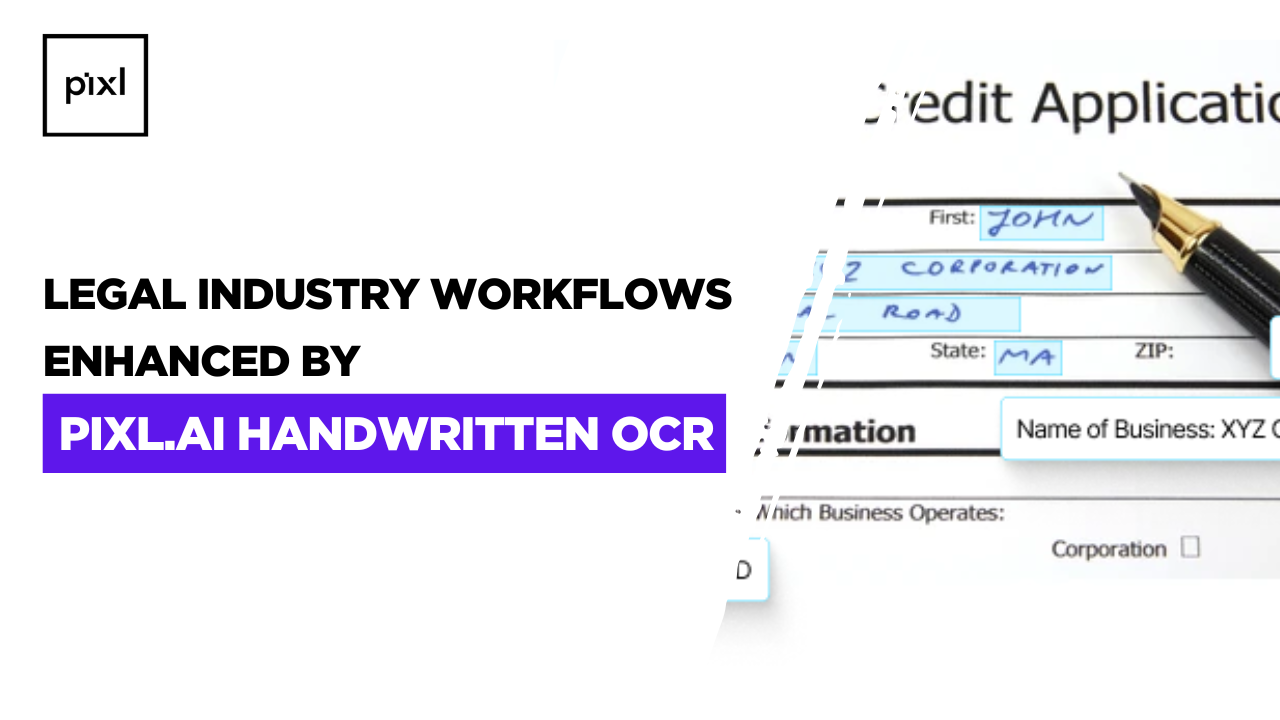
The legal industry has always been document-intensive, but by 2026 the need for faster, more accurate, and defensible document processing has become critical. While automation and generative AI have improved contract drafting and review, handwritten content remains a major gap, with client intake forms, affidavits, medical records, police reports, and courtroom notes still flowing into legal workflows and creating efficiency and compliance challenges.
This is where Pixl.ai Handwritten OCR is transforming how legal teams operate by converting handwriting into structured, searchable, and workflow-ready digital data.
Who Uses Handwritten OCR in the Legal Industry?
In 2026, handwritten OCR is no longer limited to back-office experimentation. It is actively used by:
- Law firms handling litigation, personal injury, insurance defense, and criminal cases
- In-house legal teams managing compliance records, investigations, and regulatory filings
- Paralegals and legal operations teams responsible for intake, discovery, and document preparation
- Legal service providers supporting eDiscovery, due diligence, and case management at scale
For these professionals, Pixl.ai acts as a practical enabler reducing manual data entry while preserving legal accountability and auditability.
What Is Pixl.ai Handwritten OCR?
Pixl.ai Handwritten OCR is an AI-powered document intelligence solution designed to extract handwritten text from scanned documents, images, and low-quality files and convert it into accurate, machine-readable digital data.
Unlike traditional OCR, which is optimized for printed fonts, Pixl.ai leverages:
- Machine learning models trained on handwriting variability
- Computer vision for layout and form understanding
- Context-aware AI to interpret characters, words, and fields
- Validation layers to support accuracy and compliance
The result is not just text extraction, but usable legal data that integrates seamlessly into document automation and case management workflows.
When Does Handwritten OCR Matter Most in Legal Workflows?
Handwritten OCR becomes critical at multiple points across the legal matter lifecycle, particularly when speed, accuracy, and compliance intersect:
- Client intake and onboarding – handwritten forms, declarations, and consent documents
- Litigation and discovery – handwritten witness notes, investigator reports, and annotations
- Personal injury and insurance cases – medical records, prescriptions, police reports
- Court filings and affidavits – signed, handwritten statements requiring precise digitization
- Internal reviews and investigations – notes taken during interviews or hearings
In 2026, legal teams are no longer willing to treat these documents as “manual exceptions.” Pixl.ai brings them into the same automated pipeline as digital files.
Where Does Pixl.ai Fit Into Legal Technology Stacks?
Pixl.ai Handwritten OCR is designed to integrate directly into existing legal ecosystems rather than operate as a standalone tool. Common integration points include:
- Document management systems (DMS)
- Case and matter management platforms
- eDiscovery and review tools
- Contract lifecycle management systems
- Secure cloud storage and e-filing portals
By embedding OCR at the ingestion stage, handwritten documents become structured data assets that can trigger workflows, populate fields, and support downstream automation.
Why Is Handwritten OCR Essential for Legal Teams in 2026?
1. Reducing Administrative Drag
Manual transcription of handwritten documents consumes paralegal and associate time, introduces errors, and delays case progress. Pixl.ai removes this friction by automating extraction at scale.
2. Improving Accuracy and Consistency
Legal work does not tolerate approximation. Pixl.ai applies AI-driven recognition with validation mechanisms to reduce misinterpretation of names, dates, identifiers, and clauses.
3. Strengthening Compliance and Risk Controls
With built-in audit trails, structured outputs, and support for redaction workflows, handwritten OCR becomes a compliance asset rather than a liability.
4. Supporting Ethical AI Use
As emphasized by legal ethics guidance, lawyers remain responsible for outcomes. Pixl.ai is designed to support human review, not replace professional judgment.
5. Enabling Cost Control and Operational Efficiency
By reducing rework, document handling delays, and manual intervention, firms protect margins while responding to client demands for measurable efficiency.
How Pixl.ai Handwritten OCR Enhances Legal Workflows
Step 1: Document Ingestion
Handwritten documents scanned forms, photos, PDFs are securely uploaded or captured.
Step 2: Intelligent Recognition
Pixl.ai applies AI, machine learning, and computer vision to identify handwriting, layouts, and fields.
Step 3: Data Extraction and Structuring
Key information such as names, dates, case numbers, medical details, and declarations is converted into structured data.
Step 4: Validation and Quality Checks
Rules-based checks flag missing fields, inconsistencies, or low-confidence extractions for review.
Step 5: Workflow Integration
Extracted data flows directly into legal systems, triggering document assembly, filing preparation, or review workflows.
Step 6: Audit and Governance
Every action is logged, supporting defensibility, compliance reviews, and internal audits.
Use Cases: Where Pixl.ai Delivers the Most Value
- Personal injury law – digitizing handwritten medical and police records for faster demand packages
- Insurance litigation – processing handwritten claims and investigation notes
- Regulatory and compliance matters – extracting declarations and disclosures accurately
- Legal operations – eliminating bottlenecks caused by manual intake and transcription
The Future of Legal Document Automation with Pixl.ai
By 2026, documents in the legal industry are no longer static files they are structured, intelligent workflow components. Handwritten OCR is a critical part of that evolution, closing the gap between paper-based inputs and fully automated legal processes.
Pixl.ai Handwritten OCR enables legal teams to move beyond fragmented, two-tier systems and toward a unified, AI-powered document strategy where accuracy, efficiency, and compliance coexist.
Final Thoughts
The legal industry’s shift toward document automation and AI is no longer theoretical. As handwritten content continues to flow into legal matters, the ability to accurately digitize and operationalize that information is becoming a competitive necessity.
In 2026, Pixl.ai Handwritten OCR stands out as a practical, governance-ready solution that enhances legal workflows without compromising professional responsibility or trust.